Commercial Roofing in New Castle, Indiana
Flat and low-slope membrane roofs and metal roofs on shops, churches, farm buildings and small apartment buildings. We repair and maintain first, and replace when the roof is past repairing.
Licensed general contractor in New Castle. Insured.
- One contact for the whole job: Shawn Tabor, the owner
- A written scope and price before work starts
- Work scheduled around your opening hours
The roofs we work on
Most commercial roofs here are one of these. If yours is something else, tell us what it is and we will say plainly whether we take it on.
EPDM rubber
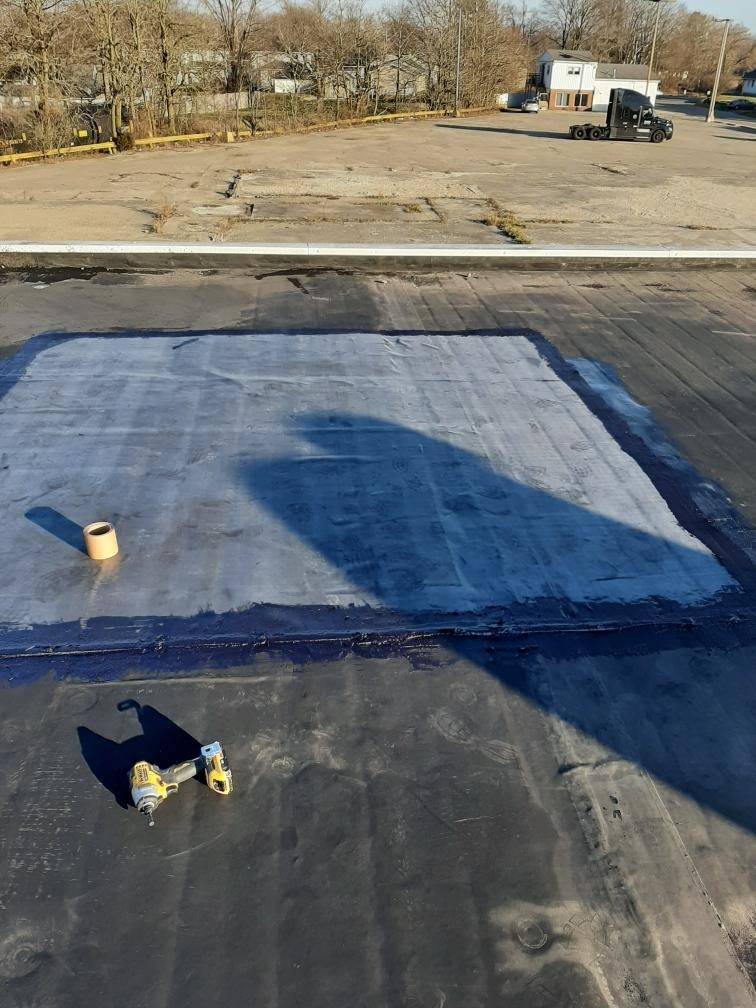
The black rubber sheet on most flat roofs here built since the 1980s. The sheet itself lasts. The glued seams and the flashing at the walls and curbs are what open up, and both can be repaired.
TPO
A white membrane with seams welded by hot air. We repair punctures and split seams, and fit it as a new roof where a reflective surface cuts the cooling load on the building.
Modified bitumen
Rolled asphalt sheets, usually with a granule surface, common on older storefronts. It cracks and blisters with age. Sound areas are repaired, and worn-out roofs are replaced or covered with a new membrane.
Metal panels
Ribbed screw-down panels and standing seam on shops, pole barns and machine sheds. Most leaks come from screws that have backed out or lost their rubber washers, and from the ridge and the panel laps.
Steep shingle roofs
Church sanctuaries, apartment buildings and older offices often have a shingle roof beside a flat one. We work on both, and on the joint between them, which is where the leaks usually are.
Drains, scuppers and edge metal
A flat roof is only as good as its way of getting water off. We clear and reseal drains, rebuild scuppers through parapet walls and replace loose coping and edge metal.
The buildings we work on
Each kind of building tends to have the same roof and the same trouble.
| Building | The roof it usually has | What we get called for |
|---|---|---|
| Shops and offices | A flat rubber or modified bitumen roof behind a parapet wall, with heating and cooling units on top | Leaks at the rooftop units, blocked drains, flashing pulling off the parapet |
| Churches | A steep shingle roof over the sanctuary and a low-slope roof over the fellowship hall or classroom wing | Leaks where the two roofs meet, valleys, and flashing around a steeple or bell tower |
| Farm buildings | Ribbed metal panels screwed to wood purlins, often with clear skylight panels | Backed-out screws, wind-lifted panels, cracked skylight panels and loose ridge cap |
| Small apartment buildings | Shingles or a low-slope membrane, with a plumbing vent for every unit | Leaks into top-floor units, cracked pipe boots, gutters and downspouts |
| Warehouses and small plants | A large low-slope membrane or metal roof with long runs to the drains | Ponding water, open seams, and leaks around exhaust fans and pipe penetrations |

Repair and upkeep first
Most leaking commercial roofs do not need replacing. They need the seams, the flashing and the drains put right. We find the leak, show you photos of it and price that repair.
The way to stop paying for emergency calls is a roof check twice a year, in spring after the freeze and thaw and in fall after the leaves are down. We walk the whole roof, clear the drains, and check every seam, curb and edge.
You get a written report with photos: what is sound, what we fixed that day, and what will need money in the next few years, in order of urgency. That report is what goes in front of an owner, a board or a budget meeting.
When a roof is past repairing we say so, show you why, and price the replacement with the options side by side.
How a commercial job goes
Five steps. Nothing starts until you have the scope and the price in writing.
You call or request a site visit.
Tell us about the building and what you are seeing.
Shawn walks the roof.
With you or whoever looks after the building, if you can spare the time. He photographs the membrane, the seams, the flashing and the drains, and looks at the ceiling below.
You get a written proposal by email.
It sets out the scope of work, the materials, the price, how long the work should take and how we will work around your hours.
We do the work on the days agreed.
You have one phone number for the whole job, and it is Shawn’s.
We walk it with you and close out the list.
Anything not right goes on a punch list and is finished before the final bill. You get photos of the completed work for your records.
Working around your business
We agree the working days and hours with you before we start. Noisy work, tear-off and anything over an entrance can be done before you open, after you close or on the days you are shut. For a church, that means the roof is closed up and the grounds are clear before Sunday.
Doors, walkways and parking that customers or tenants use stay open, or we agree a closed area with you and mark it off. No more roof is opened in a day than can be made watertight by that evening. The site is picked up and checked with a magnet for nails and screws at the end of each day.
Paperwork
Proposals, reports and invoices come by email, so they can be passed to an owner, a board or an insurer as they are.
Questions building owners ask
Can we stay open while you work?
In nearly every case, yes. A repair rarely affects the inside of the building at all.
On a replacement we agree in advance which entrances and parking stay open and when the loud work happens.
Our board needs more than one option. Can you price it that way?
Yes. A proposal can set out the repair, a larger restoration and a full replacement side by side, with what each should buy you in years. Shawn will come to a board or trustees meeting to answer questions if that helps.
Can a new roof go over the old one?
Sometimes. If the existing roof is dry, firmly attached and only one layer deep, a new membrane can go over it with a cover board between. If the insulation is wet, it has to come off. We check before we recommend either.
Do you work on roofs outside New Castle?
Yes. We work in New Castle, Muncie, Anderson, Indianapolis, Carmel and Fishers.
Request a site visit
Tell us about the building. Shawn calls you back the same business day to set a time to walk the roof, and the proposal comes to you in writing. Prefer to talk? Call or text (765) 465-1208.
Don't Labor. Call Tabor!